

Following 2010’s A Visit from the Goon Squad, Manhattan Beach (2017) is a far cry from the time-hopping experimental prose anyone might have expected. It’s a “traditional” historical novel set in Depression era/World War II New York and centred on the Navy Yards. Egan’s melancholic, Noir-esque drama is elegiac and affirmative — which was also true for Goon Squad — but its total engagement with a classical linear narrative allows for a more meditative read. This is clear from the outset. The epigraph comes from Moby Dick and reads: “…as everyone knows, meditation and water are wedded for ever.” But however steadfastly committed the narrative is to its rigidity; there’s always something universal peeking over the edge. Manhattan Beach is a historical novel, but Egan’s lens still has the same clarity and strangeness that readers expect.
The novel begins and ends with a father/daughter relationship and all of the weighty expectations that come with it. Anna Kerrigan is a protagonist whose outward innocence belies her enduring stoicism. Her father disappears and his absence shapes the novel, also allowing for the brilliantly named Dexter Styles to be brought into the equation. In Manhattan Beach, the space created through loss is often more fruitful than the moments where the characters are physically or dialectically engaged with one another. Genuine communication is always coupled with the threat of destruction, and Anna finds an escape from this threat at the naval yard where she is learns to dive in a heavy Mark Five suit.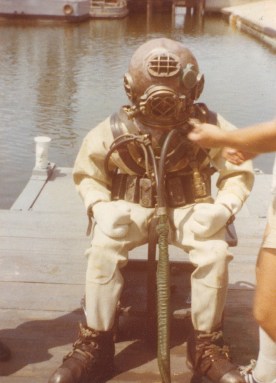 She enjoys the discipline there, and the respite it offers from the constant threat of annihilation she feels in the outside world. On speaking with another diving student we learn: “Anna liked this way of talking: An exchange of information without having to witness the wet depth of another person’s gaze.”
It hardly needs saying that in moving to the diving group Anna moves into an entirely male space, and it would be remiss not to associate the use of the word ‘gaze’ here with the rigidity of gender politics at the time. Anna occupies the uncomfortable space between ‘floozy’ and ‘angel’. Of course, being in a diving suit it matters little whether you’re either. You’re at the same risk of getting an embolism if you breathe incorrectly. Diving is a great leveller throughout the text, and so is the sea.
Manhattan Beach explicitly hones in on the connection between the sea and language at several points, including here:
Eddie had never noticed how much of his own speech derived from the sea, from “keeled over” to “learning the ropes” to “catching the drift” to “freeloader” to “gripe” to “brace up” to “taken aback” […] Using these expressions in a practical way made him feel close to something fundamental — a deeper truth whose contours he believed he’d sensed, allegorically, even while still on land.
In one of the more Modernist — and one of the most devastating — moments, we see how Anna’s profoundly disabled sister, Lydia, finds some semblance of language or communication through a visit to the sea:
I wanted you to see the sea. See the sea the sea the
ishywarmenuf?
Bird ree ree rawk reek rawk you know what birds are, remember the little birds that camrwindosill, remember?
The ocean seems to act as a conduit for Lydia to achieve a higher state of existence, but it also provides a moment of shared experience which so rarely comes without the threat I’ve already mentioned. Lydia’s role in the novel is fundamental to its exploration of love, which exists in tandem with loss throughout.
There was a feeling she had, standing at its edge: an electric mix of attraction and dread. What would be exposed if all that water should suddenly vanish? A landscape of lost objects: sunken ships, hidden treasure, gold and gems and the charm bracelet that had fallen from her wrist into a storm drain. Dead bodies, her father always added, with a laugh. To him, the ocean was a wasteland.
It’s clear here, when Anna is still a child, that the ocean offers boundless possibility to her and nothing to her father. The retrieval of a lost object is a possibility that resurfaces later in the novel, and it’s worth noting that the fear of finding something, whether it’s a charm bracelet or a dead body, might be surpassed by the fear of finding nothing at all. It’s in moments like these where the novels inhabitants seem to exist on the periphery of language and of existence itself. Take Dexter Styles crawling on the seabed, for example: “Gradually, the primal nature of the motion emptied his mind. He was crawling in the dark. Crawling in the dark. He was crawling. Crawling. After a while, he could not remember why.” The passage echoes Samuel Beckett’s Company, in which the protagonist experiences acute, excruciating solitude: “Crawling and falling then. Crawling again and falling again. If this finally no improvement on nothing he can always fall for good. Or have never risen to his knees.”
It’s easy to read the sea as purgatorial or at least liminal in terms of humanity’s collective experience. At once sustaining and destructive, it’s no wonder we see the term ‘Oceanic feeling’ in Freud’s Civilization and its Discontents as pertaining to religion:“It is a feeling which he would like to call a sensation of ‘eternity’, a feeling as of something limitless, unbounded — as it were, ‘oceanic’.”
This all amounts to a (highly subjective) digression, but the intertextuality of Manhattan Beach is self-aware. It has a feeling – despite its narrative and its focus – of being in conversation with Virginia Woolf, or Nicholas Ray or Samuel Coleridge. The appearance of an albatross seems like more than a nod to the Ancient Mariner: “He opened his eyes and saw an albatross, white and awkward, her massive wings folded at her sides like artists’ easels.”
In an interview with the Guardian in 2017, Egan said:
I thought the book would connect to 9/11, which I felt was the end of something, or at least an important event in a trajectory that had begun with the rise of America as a superpower at the end of world war two, and so there would be these leaps into the future, ie into our present. But all that was dead on arrival.
Instead of looking backwards or forwards, or ‘leaping,’ Manhattan Beach holds fast to its meditative gaze and instead simply looks out.

 Letters for Rent